Showing posts with label storage. Show all posts

Thursday, May 26, 2016

Storage: Experiments in storing coffee


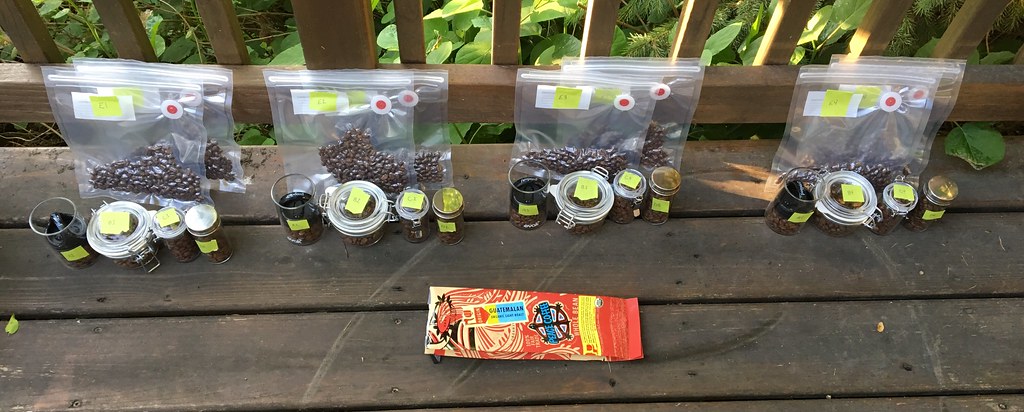
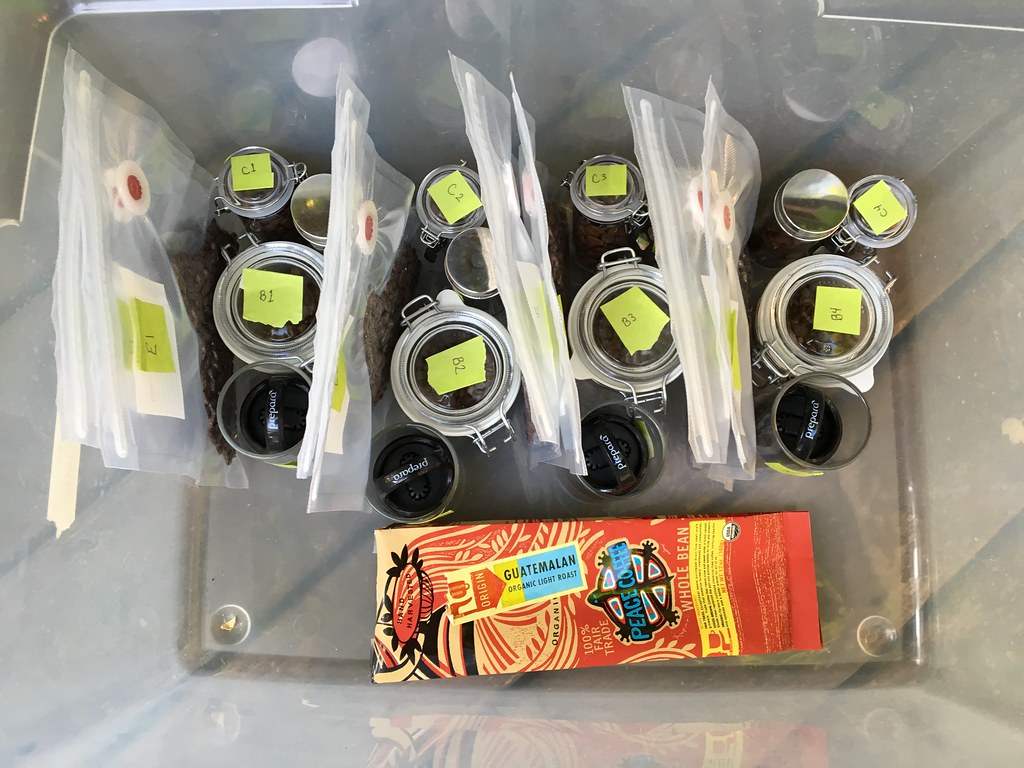
I decided to try a methodical coffee storage experiment. I'm using 5 different kinds of storage containers (plus one extra as a control), each with 33 grams (the exact amount I use each day to make coffee for Kivi and myself) of VERY fresh coffee, that was roasted yesterday (I wanted coffee roasted today, but I'll do that in the next iteration of this experiment).
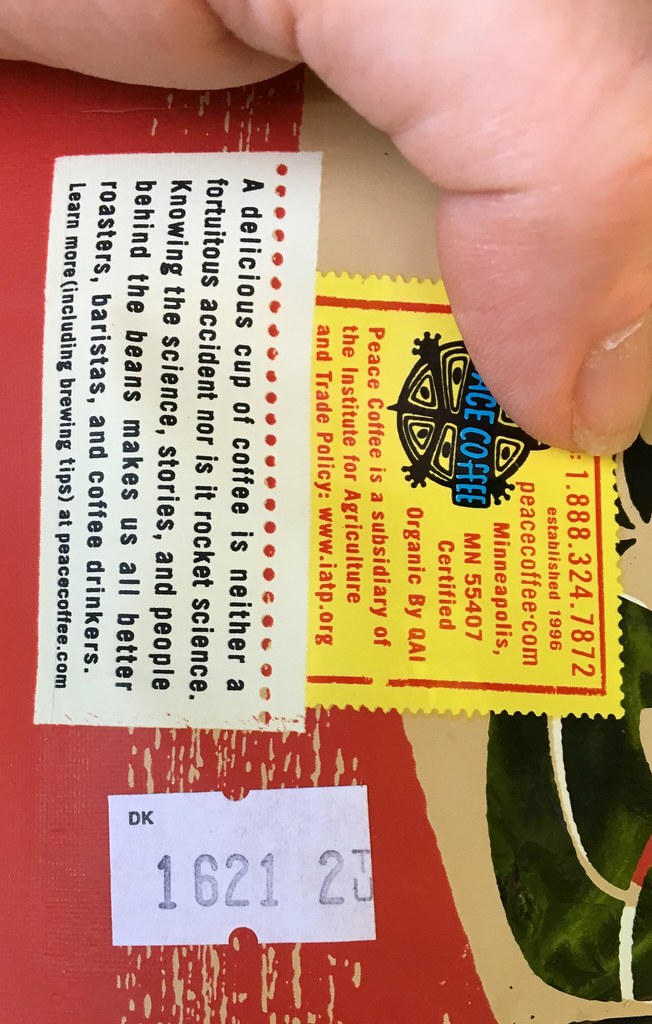
See the code on the sticker?
YYWWD (2016, week 21, Day 2 (Tues)
Here's what I did:  I got 4 each of 5 different kinds of storage, and packed the coffee in 33-gram increments in each. I'll open the first batch after one week, two weeks, three weeks, and four weeks, to see how well they keep the coffee fresh over time.

Very fresh coffee is still outgassing CO2 from the roasting, so the air-tight containers should pressurize, and the ones with valves should allow it to escape.  Anyway, here are the containers:

Container 1: 3-ounce glass spice jars with a metal screw-on lid. They held 33 grams of coffee beans easily, with only little headspace. http://www.containerstore.com/s/kitchen/spice-storage/3-oz.-glass-spice-bottle/12d?productId=10013579
I got the ones with a metal lid. There is no rubber seal, so hopefully they are airtight.
***

Container 2: 3-ounce acrylic spice jars with a bale-top and silicone or rubber seal.  These barely held 33 grams of coffee (I had to hold the lid closed, shake the jar slightly so that coffee would work its way into the recessed lid, then latch it closed). http://www.containerstore.com/s/kitchen/spice-storage/acrylic-spice-jar/12d?productId=10011992


***

Container 3: 4.25 oz/125 ml Fido bale-top canning jar with a rubber seal. These held 33 grams of coffee easily, with more headspace than I'd like.  Fidos are well-liked in the home-fermenting world, because they allow CO2 to escape when pressure builds high enough, without letting any air back in (i.e. if air was allowed back in, mold would grow on the surface of the ferment, and that rarely happens with the Fidos).  http://www.amazon.com/125-Terrine-Hermetic-Canning-Storage/dp/B00DH08GRE (we got a better price than what is shown here - shop around).
***

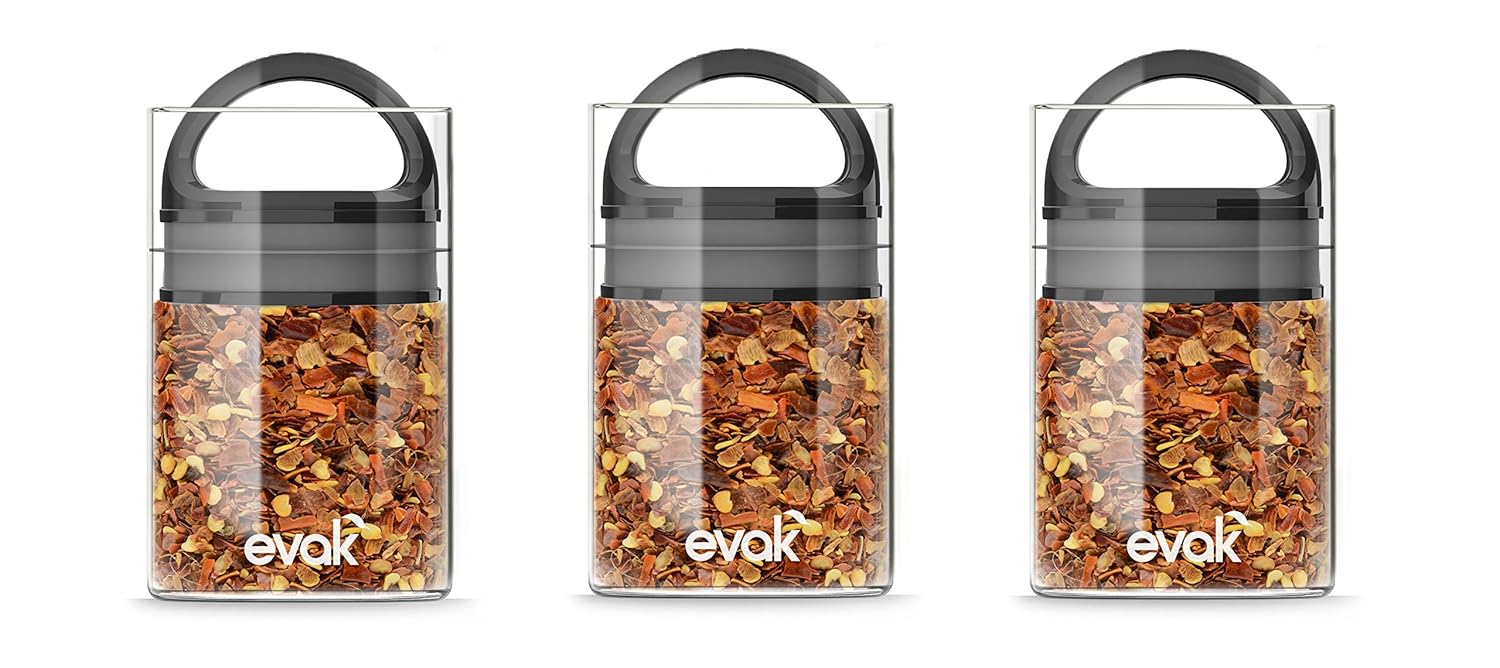
Container 4: Prepara Evak Mini containers - they shrink down to the surface of the coffee, and allow CO2 to escape. They also have a valve that prevents air from getting back in.  33 grams filled them about 1/2 way or thereabouts. They are very well-liked among coffee enthusiasts.  http://www.amazon.com/dp/B00UMXUG54/
***

Container 5: One quart Waring Pro vacuum bags (ignore the asparagus - it was a much better picture than of an empty bag).  Don't bother with the Ziploc or Freshsaver versions of these bags. You'll be lucky to get a second use out of them. The Waring Pro bags will last 20+ uses, if handled gently.  I used two bags for each week: one I intend to remove accumulated CO2 as it ougasses, revacuuming every day or so until the outgassing stops, the other I'll leave puffed up.  In my current storage methods, I remove the excess CO2.  http://www.amazon.com/Waring-PVS1000CGB-1-Gallon-Pistol-Reusable/dp/B009O9VI86/

My intent is to do a cupping each week, to see how the beans survived the storage methods over time. My daughter will mix the samples (assign a code to each), so that when I evaluate the taste of the coffee made from the beans, I will not know which sample is which. I'll take notes on my findings, but will not look at the results until all four weeks are complete.  

I intend to repeat the experiment every month for 4-5 months, using the same coffee each time. Each month I will vary the time past roasting.  This month, the coffee is roast+1 (i.e, I packed the samples one day after roasting).  Hopefully next month I'll test roast+0.  This should measure the effect of the CO2 outgassing (40% of the CO2 is lost in the first 24 hours) on storage.  Eventually, I intend to attempt (somehow) to add CO2 to the beans if they are older, to prevent the beans from being packed with any O2. But, we'll see.


The coffee came from Peace Coffee, a fairly large Twin Cities roaster. They are big enough that I'll be able to get this same coffee month after month (though they cannot guarantee that it will come from the same batch of green beans, but I can't control for everything), but small enough that they have the flexibility to work with someone like me who only wants 2 pounds of coffee, and think my geekiness is totally cool.  Only drawback is that their roastery is only open 8am-4pm Monday-Friday (in other words, during working hours, 50 minutes from my home).

Update: The next morning, I got more bags, and vacuum-packed four more samples, and froze them. In the past, I'd decided that freezing beans made them taste funny, but due to recommendations from someone online, I decided to throw freezing into the mix.  


Wednesday, May 18, 2016

Making a fresh cuppa


I've spent the last several years trying to figure out how to keep my coffee beans fresh for longer than about a week.  I love trying different coffees from all over the world, but until recently, I was only able to enjoy them for the first week, and after that, I was stuck drinking bitter, stale, mediocre brew until I ran out.

I'm a compulsive researcher, and Google yielded the same information over and over again: Coffee's enemies are heat, light, moisture, and oxygen.

Heat and light are not something I need to worry about - My house never gets very hot, and my beans are stored inside an internal cabinet (in other words, the cabinet is not built against an external wall), so they are kept in the dark, except when I'm making coffee.

Moisure? Well, I do live in the midwest, in the land of 10,000 lakes, no less (Minnesota actually has 11,842 lakes bigger than 10 acres in size).  It is very humid here. However, I think that if I manage to control the O2 exposure, that humidity will also be taken care of (with some exceptions - freezing or refrigerating beans causes condensation on the beans themselves unless you take some extra precautions).

The first thing I learned is to buy whole beans.  I figured this one out on my own - I bought some La Minita beans from Caribou Coffee, and brewed an AMAZING cup of coffee. Then my second cup the next day was pretty good.  Day three yielded a barely drinkable cup, and from then on, it was bitter and ... not really drinkable.  The beans, which I had had ground in the store had gone stale.

Once again, I turned to the internet: ground coffee keeps for a far shorter time than whole beans, because it increases the bean's surface area, and exposes more of the coffee oils to air.  Ground coffee's shelf life is about a day.  Whole beans in an airtight container last closer to a week. The key is to grind right before brewing.

So.... I bought a grinder (a Kyocera), and began buying whole beans.  And that helped enormously.  I started out grinding enough beans for my morning cup at home and for my work cup several hours later, and just carried the grounds with me to work.  But I noticed that my work cup wasn't nearly so good.  So I bought a second grinder (Hario Mini Slim), and started grinding beans right before brewing, at work, too.

This was the number one thing I did to improve the longevity of my beans.  My coffee stayed good an entire week instead of a day or two, from this step alone.

Next, I turned my experiments to storage, and refrigeration.

Initially, I tried something called a VacuVin coffee storage container. I love the brand for other things (like wine), but was unimpressed with their coffee storage. First, it didn't seem to prolong the freshness of my coffee.  I mean, it's certainly better than nothing, but I didn't find the VacuVin to be better than just leaving the beans in the original valved bags, with a rubber band to keep the air out.  And they were unreliable, required a lot of maintenance, and you never knew when it would fail to hold a vacuum.

While I was playing with the VacuVin, I experimented with and/or researched the refrigerator and the freezer. I had kept my coffee beans in the fridge when I was in college, and when I was working at a school in an area a LONG way from the teacher's lounge, I brought in a mini fridge and a coffee maker, and kept my beans in the fridge, then too.  But I didn't find that it helped then, so I didn't bother with it this time around.  My research suggested that fridge causes beans to go off FASTER - the refrigerator is a very humid place, the dried beans absorb flavors from your food, and the frequent going in and out of the cold causes condensation on the beans themselves.

I did play with the freezer some, with mixed results.  Condensation is still a problem, just as it is with the fridge.  But I found taking the following steps made the freezer a viable solution, when there is just no other choice:

  • Don't take your beans in and out of the freezer. They should go in once, and come out once, never to go back in.  Repeated moves invites condensation on the beans. Freeze them in smallish portions (like a week's worth), and once they come out, store at room temperature.
  • Wrap/pack them VERY well (vacuum-sealed is good).  
  • Wait until the beans have come up to room temp before opening the package. This prevents the condensation issue. 
(Note: Some espresso-makers like to freeze their beans in 1-serving increments, and grind them right out of the freezer - this is totally fine, as condensation on the beans immediately before brewing simply doesn't matter).

The freezer does change the flavor though, and not for the better in my opinion.  So, I believe that the cold does damage the oils, but it's better than letting a large quantity of beans go to waste.

Next I tried the Airscape canisters, and eventually the Prepara EVAKs, which are basically the same, and they are equipped with a lid with a one-way valve that slides inside the canister, collapsing with the coffee as it gets used up.  Definitely better than a mason jar, or a crock or a tupperware, which still trap air inside them.  But it wasn't until I started using the Airscapes for just that week's worth of coffee, and vacuum sealing the rest that I started to see real results.

Now, all this is only necessary, if you don't use up your beans as quickly as others. I know people who drink so much coffee, that they don't bother to store it carefully - they just drink it before it can go stale. And that's certainly a viable strategy.  But for the rest of us, who don't have as good access to fresh beans, and want to buy it in bigger quantities, buy whole beans, grind right before you brew, and store the beans away from light, heat, oxygen, and moisture.

Wednesday, May 11, 2016

Coffee Storage Review: Airscape and Evak canisters

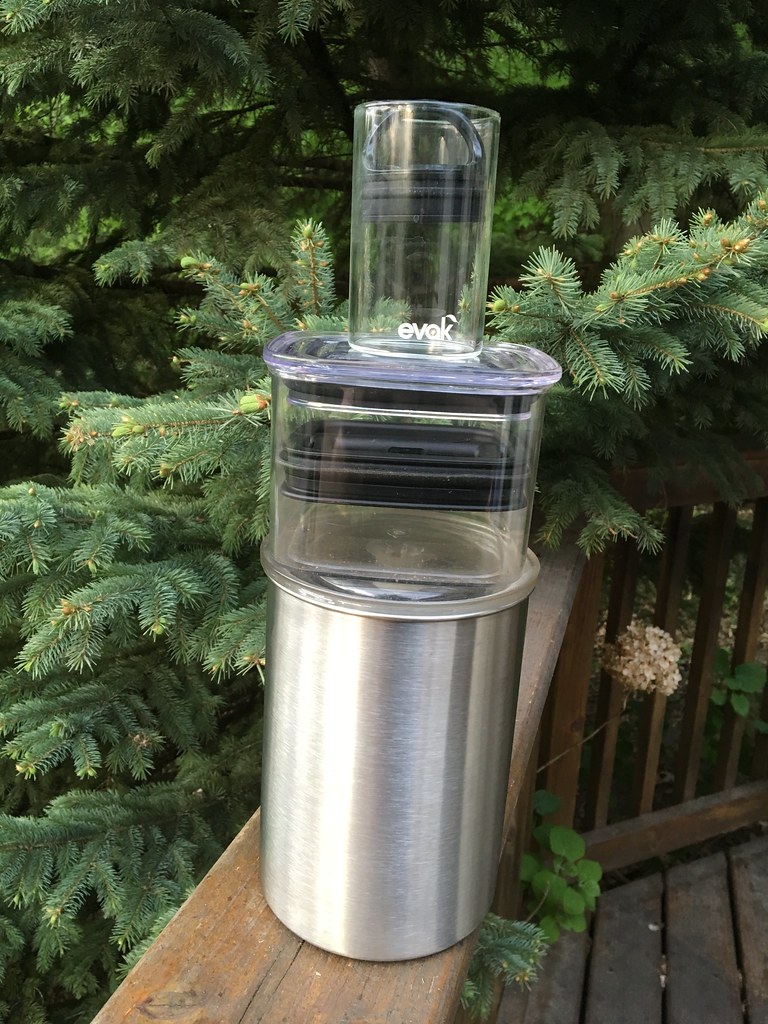
Top to bottom:
Prepara Evak mini (glass), Airscape Lite (plastic), Airscape original (stainless steel)
There's a new kind of coffee storage, that is reliable, keeps the beans fresh, and is totally convenient.  I don't know what the "class" of storage is called, or even if it even has a name, but I'll call it the "collapsing-lid canister."

Basically, they are an airtight vessel with a lid that slides down inside the canister, and rests on the surface of the coffee, thereby shrinking the size of the vessel to always fit - exactly - the amount of coffee you actually have. Think about it - regular airtight containers trap both air and food inside. Which will keep your food fresher, a container filled very full, or an almost empty one?  It's the equivalent of sucking all the air out of a ziplock bag.

The canisters are more complicated than that. The lids have a one-way valve built into them, that allows the air to escape as you collapse the lid into the vessel. It also allows any gasses released by the beans to escape as well, but doesn't allow air back in. It doesn't create a vacuum.

Airscape was the first on the scene, I think.  The original canisters were made of stainless steel, which is great for folks who store their coffee out on a counter, as they are genuinely light-tight.  The inner lid has a hinged handle - when it's upright, the valve is open, and allows air to escape as you push the lid down until it touches the surface of the coffee. Then you rock the handle sideways so it lays flat against the inner lid.  Handy if you need to fill the canister very full.  It has an outer lid for additional freshness. The first generation had a second 1-way valve on the outer lid, but newer ones do not.  Not sure the valved outer lid was necessary or not, or why they chose to eliminate it.

They now have a "Lite" version, which is made of plastic. I use these the most - I like seeing the beans through the plastic, and as much as I avoid brewing in plastic, storage of room-temperature beans in plastic isn't a problem for me. Plus, they come in a square version, and it fits in my coffee-storage bin better (to help contain the smell for my coffee-hater).  Airscape does offer a glass version, now as well, though I imagine they work just as well.  I prefer the Airscapes, because I store the coffee label between the collapsing lid and the outer lid. Especially cool, is that Airscape also offers a big version of their collapsing lid for use inside buckets, not that that is especially helpful for coffee. :-)

The Prepara Evaks only come in glass (so far as I know), and the lids meant for coffee are lined with stainless, so that only inert materials touch coffee (they do have plastic parts above the layer of stainless, however). The Evak collapsing lid handle doesn't lay flat though, which means if the canister is very full, the handle will stick up out the top. My favorites of these are the minis, which are GREAT for taking a day or perhaps two of beans with you for traveling. No outer lid, though. I doubt the outer lid is necessary for freshness, but I like it as a convenient place to store my coffee label. If you have your coffee lined up on a shelf, you can still set the label above the collapsing lid. It's just that my Evak gets stored sideways inside a plastic bin (it's tall and thin, rather than short and squat like the Airscapes), and the label falls out. Not in itself a big deal, except that I'm sloppy about putting away my old coffee labels from inside the bottom of my coffee bin, so if it falls out, I might forget which label is the correct one (well, probably not. I just like the additional lid, even if I doubt it's necessary for bean freshness).  The Evaks also offer long-handled scoops that hook over the top edge. These are handy if you get the especially tall/thin versions of their canisters.

The canisters from both companies (but not the collapsing lid) are dishwasher safe. The collapsing lids should only be wiped clean.

If you go through coffee quickly - these might not be necessary, as they really only offer modest improvements over a jar or ceramic crock for bean storage.  And they are expensive ($10 for the Evak mini, $20-$25 for bigger sizes).  But every bit helps in my opinion.

Recommended.


Wednesday, April 13, 2016

Coffee Storage Review: Vacu Vin Coffee Saver

I've spent the last several years trying to figure out how to keep my coffee beans fresh for longer than about a week.  I love trying different coffees from all over the world, but they went stale within a week or so, and then I was stuck drinking bitter, stale, mediocre brew until I ran out.

Coffee's enemies:  Heat, light, moisture, and oxygen.  I needed something that would address moisture and oxygen. Heat and light aren't a big deal, as my house doesn't get hot, and my coffee is stored in a light-tight cupboard.

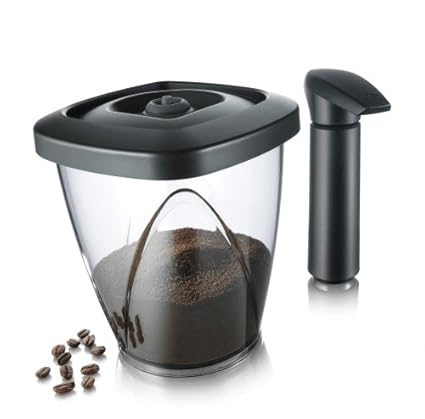
My first experiment, back in 2011 was the Vac Vin Coffee Saver:
Pic shows grounds being stored in the VacuVin.
Terrible idea - grounds go off faster than whole beans, plus
more grit is available to get caught in the seal.
I love the Vacu Vin company - I've had great luck with their wine savers, and pumping out the extra oxygen seemed like a no-brainer.  The kit comes with an extra-big air pump, which makes pumping out the air much faster than with the standard size that comes with the wine stoppers.  Great choice on the company's part. I had the taller canister pictured, plus a shorter one about 1/2 the height (bought separately) that I kept at work.

But... it didn't take long before I was dissatisfied.  Often, I'd open the canister, and discover that the vacuum had been lost overnight.  I'd find other storage for my coffee, put it through the dishwasher, then after a few days, it'd happen again.

The best advice I got, was to run a bead of cooking oil (I used a cotton swab) along the two layers of the seals, and that worked pretty well, for a time. After about 2-3 weeks, a piece of grit would get caught in the seals, which let air leak back in. So, I'd brush out the seals, and re-oil them.  That level of maintenance isn't the end of the world (I make my coffee using only manual methods), but sometimes the oil would keep it sealed reliably for a few weeks, and at other times, just a few days.

And ... my week of fresh coffee before it started tasting bitter and stale wasn't prolonged, not as far as I could tell.  It's better than storing them in an open bin. It is probably even better than storing them in a mason jar on the counter, as the Vacu Vin is darkened - like built in sunglasses for your beans. But beyond that? Nah.  After a year or so, I gave the canisters to my brother.

Note: I've seen comments online that suggest that storing beans in a low-pressure container will cause the oils to migrate out (be sucked out??) of the beans, and make them go rancid sooner.  As far as I can tell, that's just speculation, with little basis in fact. My beans didn't get the slightest bit shinier or more oily-looking when stored in the Vacu-Vin.  I just didn't find that it kept them any fresher than any closed jar.